How much time should you really plan for the Marrakech-Ouarzazate route? Expect about 190 to 200 km and around 4 hours of driving without stops, according to the benchmarks of day trips from Marrakech. This is a mountain road, not a highway between two cities.
A typical excursion brochure still announces a "quick" crossing, as if the High Atlas could be traversed at the pace of an expressway. The real risk lies elsewhere: underestimated duration, overtaking without visibility, and driving at night.
The road is paved and better equipped than it was a few years ago. An early morning departure, an appropriate speed, and planned breaks are enough to make the crossing serene.
Table of Contents
- Duration and distance of the journey at a glance
- Choosing the right car for the pass ascent
- Preparing for departure from Marrakech
- Driving the Tizi n'Tichka pass safely
- Must-see stops between Marrakech and Ouarzazate
- Frequently asked questions about the Marrakech-Ouarzazate journey
- Book your car for Marrakech–Ouarzazate
Duration and distance of the journey at a glance
The mileage can be misleading on this route. On the N9, expect about 196 to 200 km, a passage through the Tizi n'Tichka pass at about 2,260 m, and a drive generally estimated between 3 hours 30 minutes and 4 hours 30 minutes without stops, according to a benchmark for day trips from Marrakech. An early departure is what makes this range realistic.
The arrival time varies mainly due to the exact starting point, the exit from Marrakech, roadworks, and breaks in the High Atlas. Behind a heavy truck or a bus, a queue can take several minutes without any morning itinerary accounting for it. Night adds another problem: curves are harder to read, and overtaking requires visibility that the mountains do not always provide.
| Benchmark | Value | What to remember |
|---|---|---|
| Route taken | N9, two-lane mountain road | Overtaking only with long visibility |
| Winter conditions | possible closures due to snow | Check road conditions on the day of departure |
| Time traps | queues behind trucks, departure from the center, breaks | The odometer alone is not enough to plan |
The road leaves the Marrakech plain, gradually ascends to the pass, and then descends towards the pre-Saharan plateau of Ouarzazate. This elevation explains the slow pace. I would consider any time slot promising an arrival before noon without an early departure to be optimistic.
Planning rule: reserve the morning for the journey alone. An early departure aims for an arrival in late morning or early afternoon, before adding any visits.
Choosing the right car for the pass ascent
The N9 is paved from Marrakech to Ouarzazate, and an automatic SUV is sufficient to ascend effortlessly. What matters here is comfort on the long slopes, luggage space, and a gearbox that keeps both hands on the wheel in the hairpins.
An automatic transmission avoids searching for the right gear at every bend, allowing your eyes to stay on the path. A small city car can also make the ascent, but the cabin quickly becomes cramped as a family stacks suitcases and bags.
| Model | Category | Advantage on this route |
|---|---|---|
| Dacia Duster | SUV | Comfort and volume for luggage |
| Peugeot 2008 | Compact SUV | Smooth driving and comfort in the ascent |
| Hyundai Tucson | SUV | More space for passengers and luggage |
The Dacia Duster is suitable for two or three travelers who want good trunk space without taking a large vehicle. The Peugeot 2008 remains more compact, with smooth driving that helps on long climbs. The Hyundai Tucson takes over as soon as passengers and luggage really fill the cabin.
Size matters more than engine power. To compare these categories before booking, the page SUV rental in Morocco groups the sizes suitable for this type of connection.
If the rest of the journey leaves the pavement for tracks or dunes, even a 4x4 is subject to the same rules: you drive on authorized roads and tracks, never in protected dunes, and a local guide takes over for deep desert trips. Beyond five passengers, a 7-seater vehicle or minibus is available, with availability varying by city and season. Confirm the dates, city, and number of people on WhatsApp at the time of booking, without locking in a specific model in advance.
Preparing for departure from Marrakech
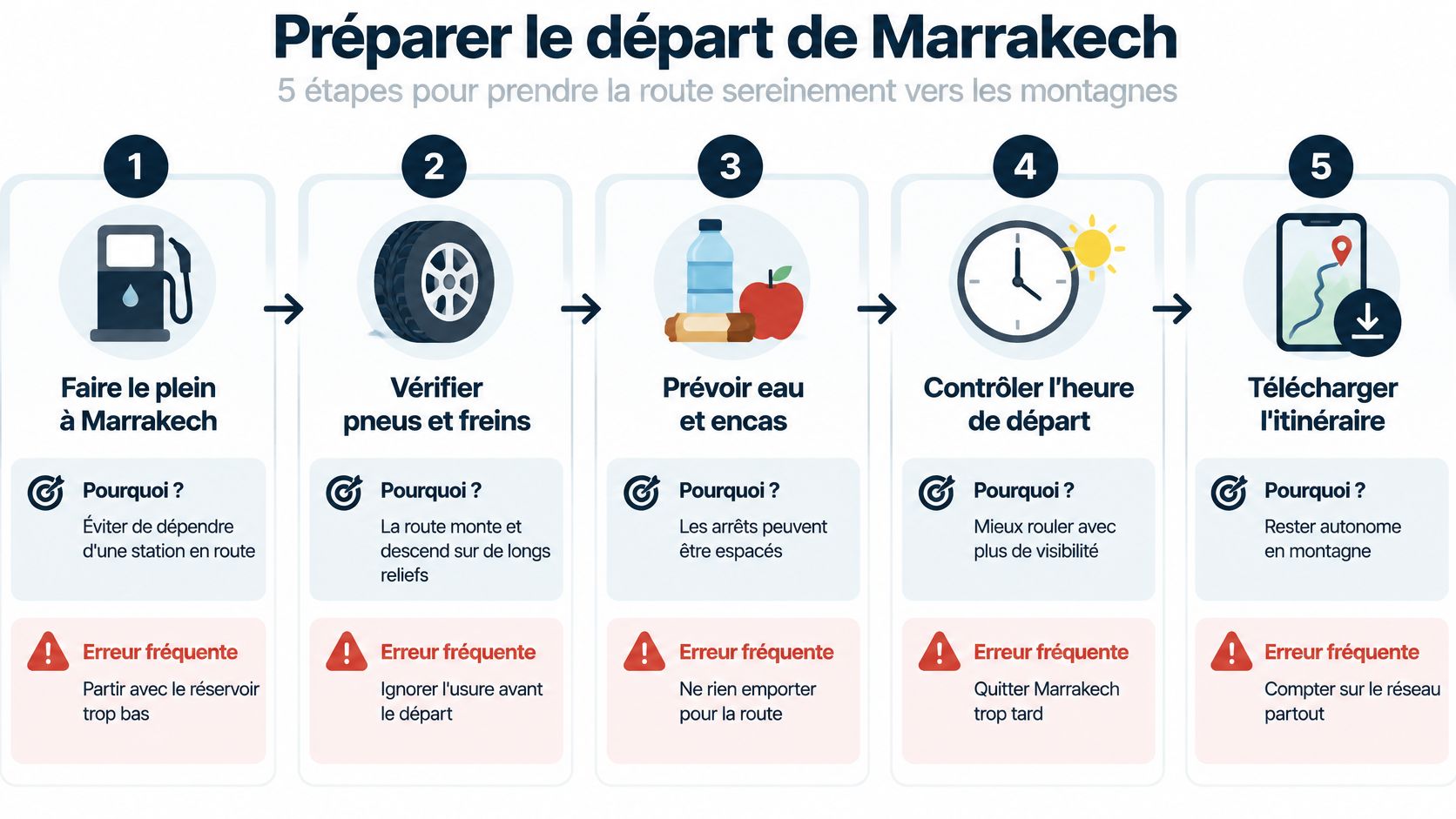
Five actions, in order, can avoid most ruined days. Each addresses a mistake that travelers often repeat.
- Fill up in Marrakech. A full tank avoids searching for a station in the middle of the ascent, where stopping is neither practical nor guaranteed. Leaving with a low gauge adds a detour at the worst moment.
- Leave early in the morning. The goal is to be on the other side of the pass before the end of the day. The most common mistake is leaving the city too late and then negotiating the last turns at night.
- Check the weather and road conditions on the day itself. From December to February, snow can sometimes close the passage. The N9 at Tizi n'Tichka has been reported closed on December 1 and 16, 2025, from January 18 to 20, 2026, and on January 24, 2026, with over 90 centimeters of snow in some places during the January episode, according to a report on winter in Morocco.
- Allow for about 4 hours without stops. Underestimating this duration pushes you to drive faster than visibility allows. The margin absorbs a slow truck or a photo stop without stealing from the afternoon.
- Prepare your belongings before turning the key. Phone charged, water, papers, and luggage secured. A sliding bag or a document searched for at a red light diverts attention right from the first hairpins.
The decision to make before driving
If snow is forecasted or if the road is closed, postpone. Forcing the pass "not to lose the day" is the wrong calculation. A foreign license is sufficient to drive; an international license is accepted but not required. Details of useful documents are on the license guide for Morocco.
If the morning bulletin mentions snow on the Tichka, the right decision is to stay in Marrakech and leave when the N9 is reopened.
Driving the Tizi n'Tichka pass safely
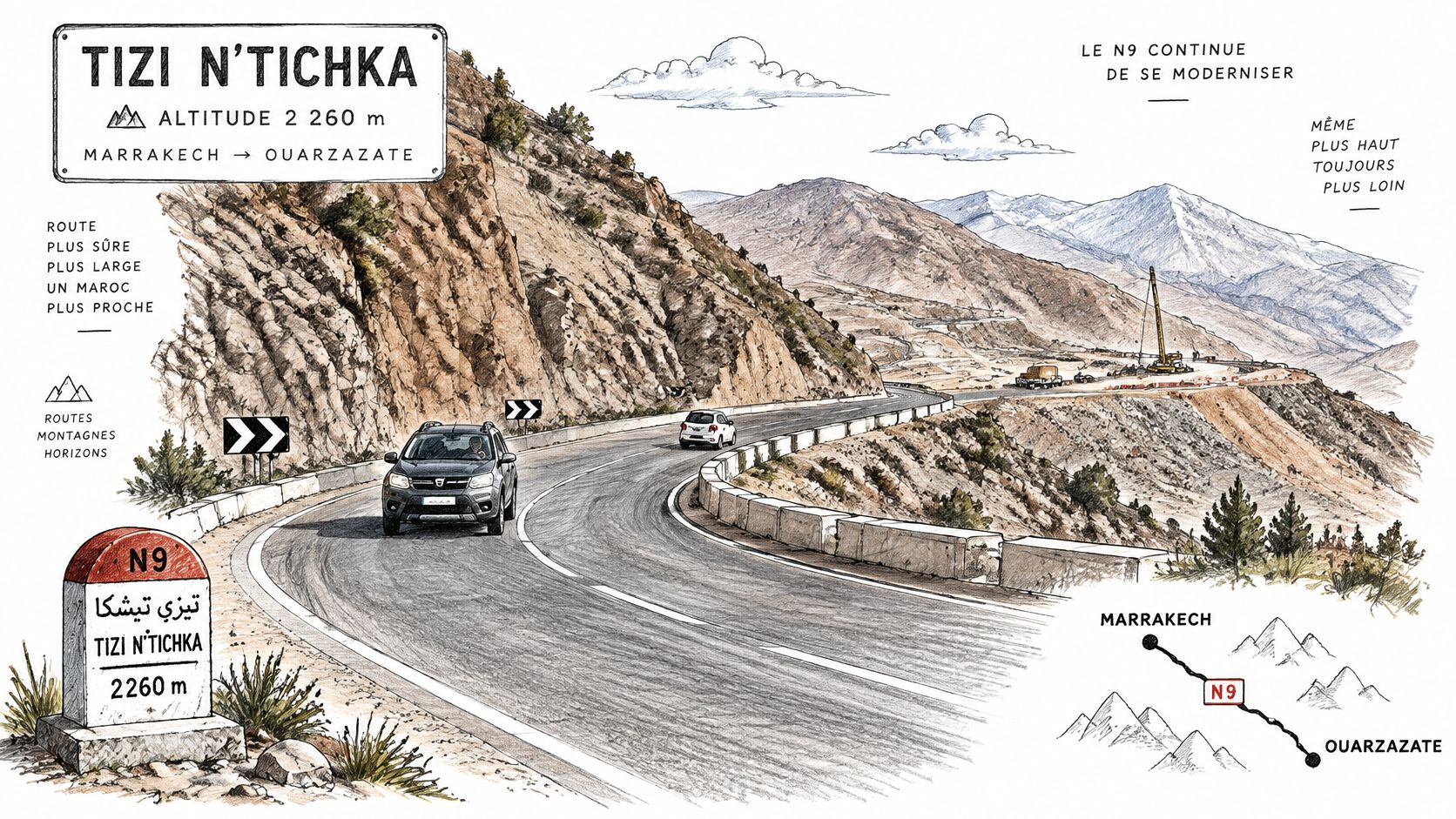
The reputation of an extreme road is dated. The N9 development program has planned widenings, corrections, pavement reinforcement, and additional lanes in steep areas. Some of this work is completed. However, as a article on road trips from Marrakech reminds us, the route remains a two-lane mountain road, with tight turns, slow heavy vehicles, and sometimes reduced visibility. The pavement is no longer everywhere the "extreme course" of old tales. It still requires an appropriate speed and a refusal to cross at night.
Important actions in the hairpins
Engine power matters less than vigilance. An automatic SUV is sufficient. No one needs a 4x4 for this pavement.
- Adjust speed for each turn. Slow down before the curve, not in the middle, and only regain speed when the exit is visible.
- Downshift on long descents. A lower gear limits brake overheating. Just holding the brake pedal for a long time tires the system.
- Keep your distance behind heavy trucks and buses. When the road narrows, let them pass instead of tailgating.
- Never overtake in a curve or without visibility. A slow truck does not justify a blind maneuver. Wait for a clear straight line.
- Take a break as soon as fatigue sets in. Ten minutes in a safe parking area are better than negotiating the last turn distractedly.
The general driving reflexes in Morocco, including controls and priorities, are covered in the practical guide for driving in Morocco. On this pass, the useful skill is simple. Look far, brake early, and let slower vehicles pass.
Must-see stops between Marrakech and Ouarzazate
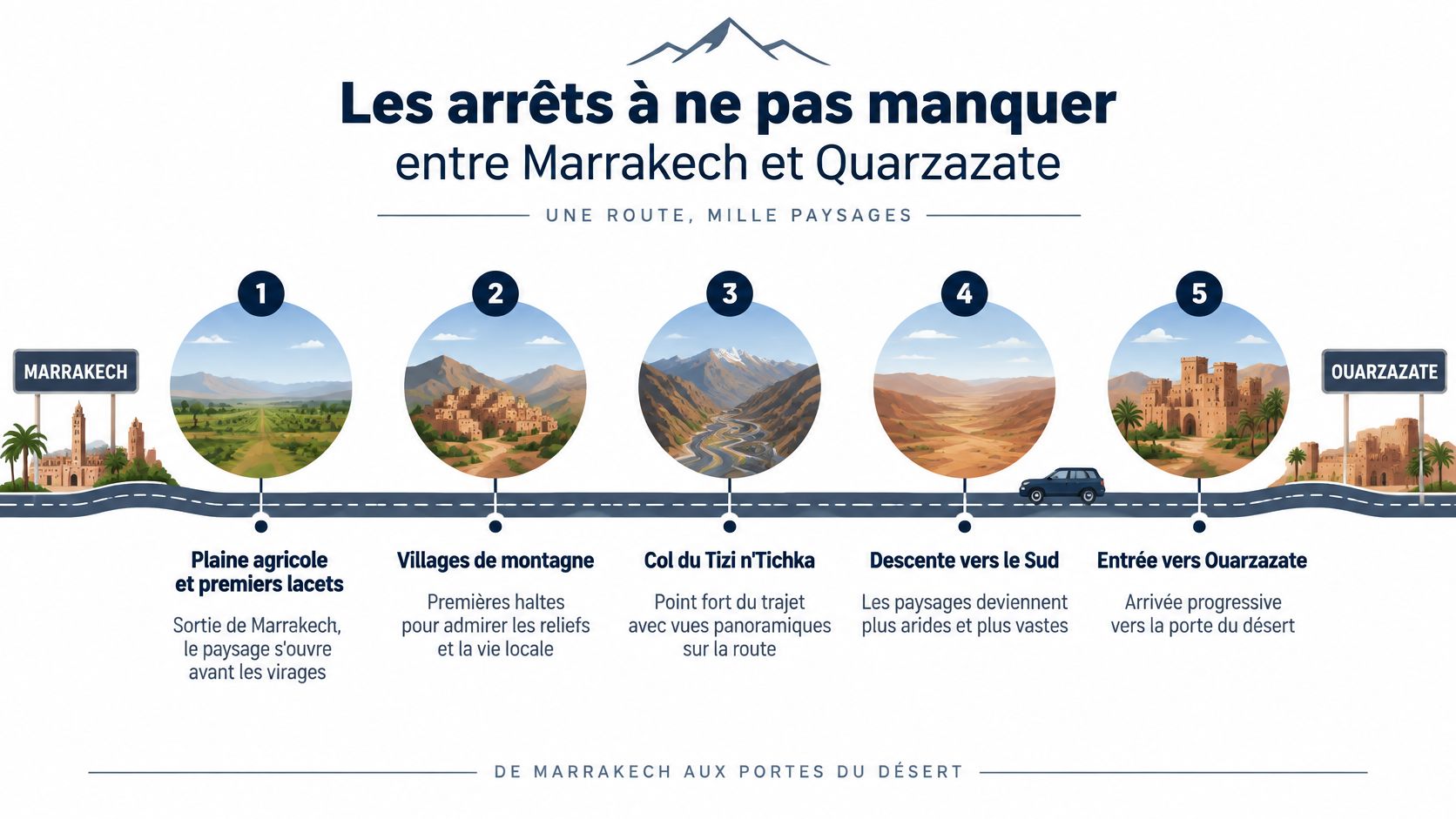
The journey is read in the order it is driven, and the light sets the limit. Departing early from Marrakech, you can fit in two or three stops without turning the end of the day into a night descent. Departing late means you have to choose.
The exit from Marrakech first crosses the agricultural plain. Fields and villages replace the city, then the first hairpins signal the mountains. There’s no need to stop long here: it’s time to find your rhythm, not to visit.
The ascent leads to the pass. The viewpoints of Tizi n'Tichka are the simplest break to place in the morning, with a strict rule: park only where it is allowed, never in a curve for a photo. The route leaves the Marrakech plain, crosses the ridges, and then descends towards the pre-Saharan plateau, as described in the travel guide to Ouarzazate.
Two detours, not three
After the pass, the southern slope opens up, more mineral, drier. The secondary road to the kasbah of Telouet climbs a narrow valley, and the earthen kasbah, partially ruined, remains open for visits. This detour lengthens the day: only add it if arrival in Ouarzazate remains during daylight, and check access before leaving the N9.
Aït-ben-Haddou comes just before Ouarzazate. This earthen ksar, listed as a UNESCO World Heritage site, is the last logical stop. Parking, walking to the site, and visiting take more time than just the road detour, so aim for it in the mid-afternoon rather than at dusk.
Ouarzazate then opens the Draa Valley and, further on, the tracks towards the desert. Continuing the same day to Merzouga would turn a beautiful connection into a race against the sun; planning a longer itinerary should be done separately, as on the Marrakech-Merzouga by car route.
Frequently asked questions about the Marrakech-Ouarzazate journey
Can you do the round trip in one day?
This is not a good plan. Each direction takes about 4 hours of driving without stops, so the day is almost entirely spent driving. There’s too little time for Aït-ben-Haddou or even for a proper break at the pass.
Should you plan a night in Ouarzazate?
One night changes the pace. You can visit the ksar at the end of the day or the next morning, without worrying about the return time. It’s the most comfortable choice once a photo stop is no longer enough.
Can you pick up the car in Marrakech and return it in Ouarzazate?
Yes. One-way rentals between the two cities are offered without return fees, and delivery and pickup are done at the chosen address, hotel, riad, or other point in Moroccan cities. This must be requested at the time of booking, not upon arrival.
Does Route Facile offer a driver or excursions?
No. Route Facile is a car rental company without drivers and does not offer drivers or excursions. To be driven, you need a specialized provider. Renting remains the solution when you want to take the wheel yourself, with a second driver included and no young driver surcharge.
Book your car for Marrakech–Ouarzazate
Once the departure time and stops are chosen, the day's program dictates the choice of vehicle. Route Facile is a licensed Moroccan rental company based in Marrakech, which delivers and picks up the car for free at Marrakech Menara Airport, at the hotel, riad, or specified address, 24/7. The handover takes place at the arrivals exit or at the agreed address, at a time that suits you.
Upon pickup, the driver presents passport and license. A Moroccan resident presents their CIN and license. The minimum age is 21, with a license held for at least one year. A foreign national license is sufficient, and an international license is accepted but not required.
No security deposit is required, nothing is blocked on a card, and a credit card is not necessary to book. Full insurance is included with no excess, and civil liability, mandatory in Morocco, is always included in the base rate. Mileage is unlimited. Cancellation is free up to 24 hours before pickup, with a full refund of the advance payment. Daily rates start from 250 DH/day. The daily price can be checked on the website.
Three ways to pay: pay 15% in advance online, pay in full, or book without a card and pay upon pickup. The concrete process for pickup in Marrakech is detailed in the car rental guide in Marrakech.
To cross the Tizi n'Tichka during the day, with an automatic SUV and no security deposit, book the time slot that matches your departure time. Route Facile delivers the car to Marrakech Menara, to the hotel or riad, even for an early morning departure. Contact the team on WhatsApp or by phone to confirm dates, city, number of passengers, and model availability.